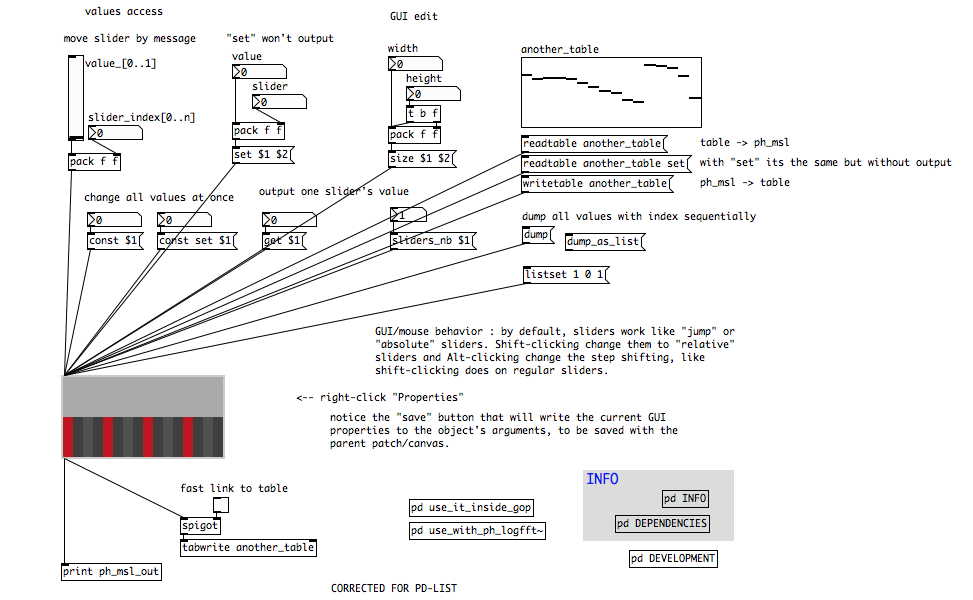
[ph_msl]

ph_msl-help

[ph_msl] is a multislider GUI with persitent parameters for interface/graphic setup and conceived as an « abstraction ».

It relies on 4 « compiled » externals from 3 libraries – mostly in order to perform dynamic-patching, state-saving and user events capture :

[iemguts/canvasargs]
[iemguts/propertybang]
[iemgui/iem_event]
[iemlib/dollarg]

Moreover, for the sake of avoiding redundant code, this abstraction is provided with 8 homemade abstractions,
– 6 about color-format conversion :

ph_iem2rgb

   ph_iem2web

ph_rgb2iem

   ph_rgb2web
   ph_web2iem
   ph_web2rgb
– 1 control facility :
   ph_skip
– and 1 GUI abstraction for picking colors and to avoid dependency on [hcs/colorpanel] :
   ph_g.colorpicker


To try it : download & uncompress the archive below :
> ph_msl_updated (11/07/2016)
It has been tested with pd-0.46-7 and pd-0.47-1 on MacOS X 10.10.5, and necessary libraries from the « deken » utility.

I’m happy to receive any comments on this : phae_dot_ilias_at_gmail_dot_com

python wave

bases en python >>> FLOSS Manual : Initiation à Python >>> http://www.flossmanualsfr.net/initiation-a-python/

la librairie « wave » assez simple d’utilisation : https://docs.python.org/2/library/wave.html

premier tests sous python :

# -*- coding:utf-8 -*-

import wave, struct

sndfile = wave.open("Lusitania.wav",  'r')
print sndfile.getparams()
sndfile.setpos(48200)
frames = sndfile.readframes(12)
print(len(frames))

i = 0
while i < len(frames):
        oneframe = frames[i:i+2]
        print(len(oneframe))
        data = struct.unpack("<h", oneframe)
        print(data)
        i+= 2

sndfile.close()

également la librairie externe PyMedia (http://www.pymedia.org) qui permet de lire directement un CD Audio

à noter les spécificités du CD Audio (voir notamment https://en.wikipedia.org/wiki/Compact_Disc_Digital_Audio#Frames_and_timecode_frames) : il semblerait que, au moins dans la TOC (Table Of Content) les durées et positions soient inscrites en « frames » de 588 paire d’échantillons (gauche et droite) soit 1/75e de seconde (588 x 75 = 44100). Donc il s’agit du « grain », de l’unité minimale de durée.
(à vérifier tout de même avec un autre outil (par ex : rip puis pd [soundfiler] voir si on a des durées qui ne sont pas multiples de 588)

également à propos du format WAVE : un bon document >> http://web.archive.org/web/20080113195252/http://www.borg.com/~jglatt/tech/wave.htm