Catégorie : ressource


Background Noise : Perspectives On Sound Art – Brandon LaBelle (2006)

La Brique Internet
![[ph_msl]](https://atwrk.phae.eu/wp-content/uploads/2016/07/ph_msl_gui.png)
[ph_msl]
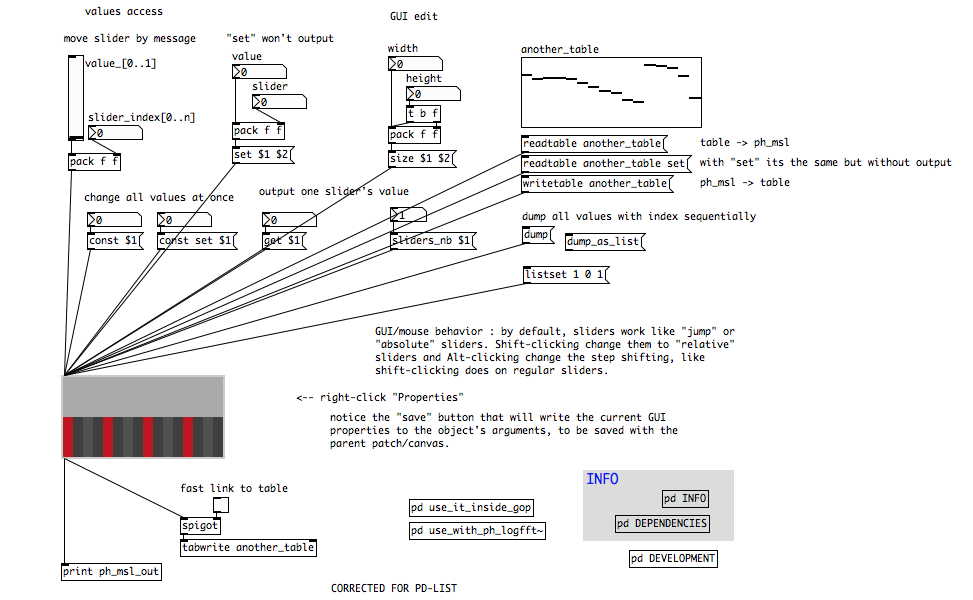
[ph_msl] is a multislider GUI with persitent parameters for interface/graphic setup and conceived as an « abstraction ».
It relies on 4 « compiled » externals from 3 libraries – mostly in order to perform dynamic-patching, state-saving and user events capture :
[iemguts/canvasargs]
[iemguts/propertybang]
[iemgui/iem_event]
[iemlib/dollarg]
Moreover, for the sake of avoiding redundant code, this abstraction is provided with 8 homemade abstractions,
– 6 about color-format conversion :
– 6 about color-format conversion :
ph_iem2rgb
ph_iem2web
ph_rgb2iem
ph_rgb2web
ph_web2iem
ph_web2rgb
– 1 control facility :
ph_skip
– and 1 GUI abstraction for picking colors and to avoid dependency on [hcs/colorpanel] :
ph_g.colorpicker
To try it : download & uncompress the archive below :
> ph_msl_updated (11/07/2016)
It has been tested with pd-0.46-7 and pd-0.47-1 on MacOS X 10.10.5, and necessary libraries from the « deken » utility.
I’m happy to receive any comments on this : phae_dot_ilias_at_gmail_dot_com

user input simulation
à propos de John Cage et d’une philosophie du silence
superbe émission Les nouveau chemins de la connaissance (France Culture) avec une discussion sur John Cage et son œuvre, et particulièrement sur le plan philosophique.
plagiat audio : quelques liens
FORUM « SAMPLES »
http://saceml.deepsound.net/archives/archi3.html
http://saceml.deepsound.net/archives/archi4.html
http://saceml.deepsound.net/archives/archi75.html
ARTICLES « SAMPLES »
http://www.konbini.com/fr/entertainment-2/sampling-et-droits-dauteur/
https://en.wikipedia.org/wiki/Legal_issues_surrounding_music_sampling
https://fr.wikipedia.org/wiki/%C3%89chantillon_%28musique%29#Questions_juridiques
python wave
bases en python >>> FLOSS Manual : Initiation à Python >>> http://www.flossmanualsfr.net/initiation-a-python/
la librairie « wave » assez simple d’utilisation : https://docs.python.org/2/library/wave.html
premier tests sous python :
# -*- coding:utf-8 -*-

import wave, struct

sndfile = wave.open("Lusitania.wav",  'r')
print sndfile.getparams()
sndfile.setpos(48200)
frames = sndfile.readframes(12)
print(len(frames))

i = 0
while i < len(frames):
        oneframe = frames[i:i+2]
        print(len(oneframe))
        data = struct.unpack("<h", oneframe)
        print(data)
        i+= 2

sndfile.close()
également la librairie externe PyMedia (http://www.pymedia.org) qui permet de lire directement un CD Audio
à noter les spécificités du CD Audio (voir notamment https://en.wikipedia.org/wiki/Compact_Disc_Digital_Audio#Frames_and_timecode_frames) : il semblerait que, au moins dans la TOC (Table Of Content) les durées et positions soient inscrites en « frames » de 588 paire d’échantillons (gauche et droite) soit 1/75e de seconde (588 x 75 = 44100). Donc il s’agit du « grain », de l’unité minimale de durée.
(à vérifier tout de même avec un autre outil (par ex : rip puis pd [soundfiler] voir si on a des durées qui ne sont pas multiples de 588)
également à propos du format WAVE : un bon document >> http://web.archive.org/web/20080113195252/http://www.borg.com/~jglatt/tech/wave.htm
organismes phono-logiciels (OlinuXino)
notes sur l’installation & la configuration du système et de puredata
Continuer la lecture de organismes phono-logiciels (OlinuXino)
puredata exprmnt+learn
rapide prise de notes d’élaborations en autodidacte, expérimentations, mise en application d’apprentissages, sous puredata, ces dernières semaines…
à détailler…. Continuer la lecture de puredata exprmnt+learn